

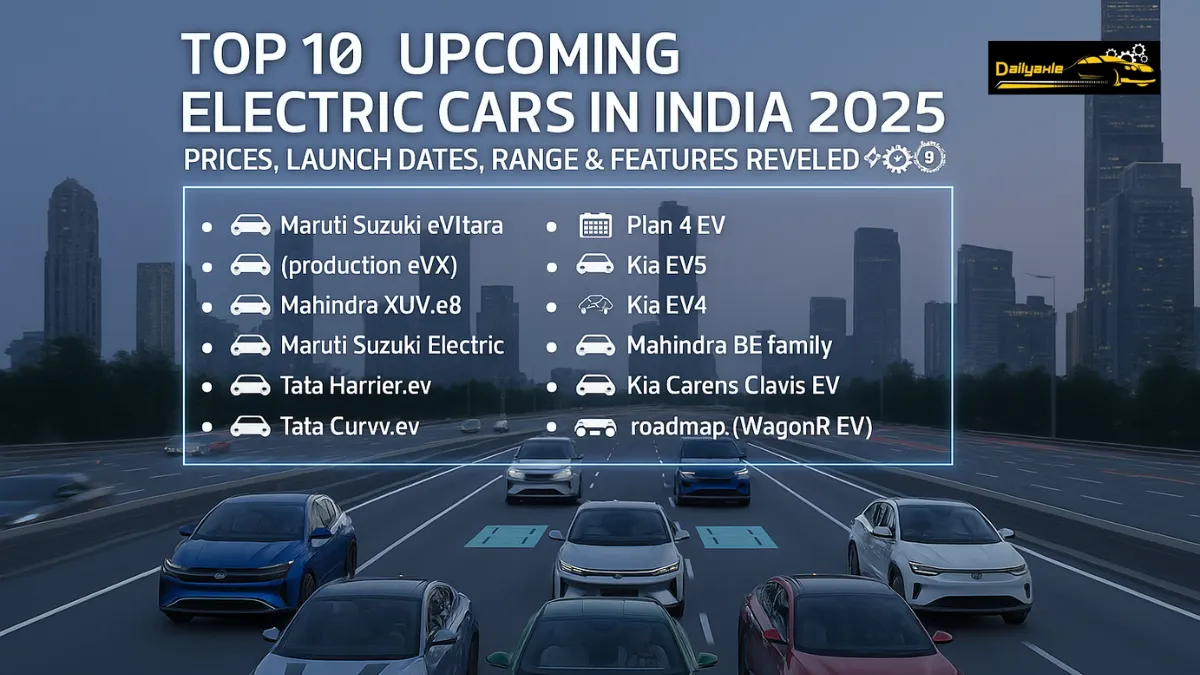
Quick comparison table — Top 10 at a glance
| # | Model | Expected Price (₹ ex-showroom) | Claimed/Expected Range | Launch Window / Status (India) | Why it matters |
|---|---|---|---|---|---|
| 1 | Maruti Suzuki e-Vitara (production eVX) | ₹17–26 Lakh (est.) | ≈400–500+ km (claimed) | 2025 — revealed; mass launch in 2025 (festive window expected) | Maruti’s broad dealer reach could make it the first true mass-market EV for India. |
| 2 | Mahindra XUV.e8 / XEV 7e | ₹25–35 Lakh (est.) | ≈400–650 km (depends on battery) | Expected production & phased sales through 2025 | Large SUV option with 7-seat variants — important for family buyers wanting space. |
| 3 | Hyundai Creta Electric | ₹18–22 Lakh (est.) | ≈400–470 km (company / WLTP figures) | Launched/rolling out through 2025 | Creta nameplate in EV form — high serviceability and brand trust. |
| 4 | Tata Harrier.ev | ₹21–30 Lakh (est.) | Up to ~600+ km (top packs claimed) | Launched/available in 2025 | Long-range Tata SUV with ADAS and family-focused features. |
| 5 | Tata Curvv.ev | ₹17–22 Lakh (est.) | ≈430–500 km (claimed) | On sale / bookings in 2025 | Coupe-SUV design with strong value for money. |
| 6 | MG 4 EV | ₹28–32 Lakh (est.) | ≈350–450 km (pack dependent) | Expected India introduction late 2025 | Modern hatchback EV that brings global battery tech to India. |
| 7 | Kia EV5 | ₹30–55 Lakh (est., localization dependent) | ≈400–520 km (global figures) | Global rollout 2024–25; India timing depends on localisation | Premium SUV on an established EV platform — aspirational product. |
| 8 | Mahindra BE family (BE.05 etc.) | ₹12–22 Lakh (est.) | ≈300–450 km (depending on pack) | Concepts shown; production variants 2025 onward | Compact, affordable EVs to fill the value end of the market. |
| 9 | Kia Carens Clavis EV | ₹18–20 Lakh (est.) | ≈300–400 km (real world varies) | Launched / bookings in 2025 | Family-oriented MPV with EV efficiency — practical for multi-passenger use. |
| 10 | Maruti small EV roadmap (WagonR EV / city EV) | ₹8–12 Lakh (aspirational) | ≈200–350 km (entry packs) | Roadmap suggests compact EVs in 2025–2026 window | A true affordable Maruti EV would dramatically increase EV adoption in India. |
Related News

Detailed notes — what to expect for each model
1. Maruti Suzuki e-Vitara (production eVX)
Why watch it: Maruti controls a massive slice of India’s passenger market — when they commit to EVs at scale the ripple effects are big. Expect two battery sizes aimed to balance price and range, strong service and parts reach through NEXA dealers, and an emphasis on low cost of ownership. Real-world range will depend heavily on battery size and local driving patterns; conservative buyers should treat manufacturer claims as best-case numbers.
2. Mahindra XUV.e8 / XEV 7e
Why watch it: Mahindra is building on SUV DNA. The XUV.e8 is aimed at families needing space and, possibly, 7-seat flexibility. Big battery options and rugged suspension are the likely USPs. Pricing and variant choice will determine whether it competes with Tata’s larger EVs or targets a different buyer.
3. Hyundai Creta Electric
Why watch it: Hyundai is good at taking proven nameplates and converting them to high-volume EVs. Expect good dealer support, refined cabin features and a pragmatic balance of range and price. If you want a low-fuss EV backed by reliable service, this is a strong contender.
4. Tata Harrier.ev
Why watch it: Tata aims the Harrier.ev at buyers who need range and an SUV’s presence. With larger battery options, connected tech and ADAS features, this car is for users who travel longer distances and want assurances on warranty and service from a local brand that already understands Indian roads.
5. Tata Curvv.ev
Why watch it: Coupe-SUV styling, competitive pricing and Tata’s growing EV ecosystem make the Curvv.ev a practical pick for many buyers. Good interior quality and value-for-money features are expected.
6. MG 4 EV
Why watch it: If MG brings the global MG4 spec to India, buyers will get a modern, well-packaged hatchback with competent range and efficient battery technology. It’s more premium than a small city car but can offer strong driving dynamics for its price bracket.
7. Kia EV5
Why watch it: The EV5 is an aspirational product and, if localized, will raise expectations for features and charging speed in the mid-to-premium EV SUV segment. Expect fast charging capability and a tech-forward cabin.
8. Mahindra BE series (BE.05 etc.)
Why watch it: These compact electric models are Mahindra’s answer to the entry and mid-level segments. Local engineering and production could allow competitive pricing and pragmatic features for Indian buyers who want affordable range and durability.
9. Kia Carens Clavis EV
Why watch it: A family-first MPV with EV efficiency: seven-seat practicality, multiple seating layouts and a focus on occupants’ comfort. A sensible choice for larger families moving to electric mobility.
10. Maruti small EV roadmap (WagonR EV & friends)
Why watch it: A low-cost, high-volume Maruti EV is the inflection point for mass adoption. If Maruti can keep costs, maintenance and charging simple, the WagonR EV (or its sibling) will be the people’s EV.